
Paid·Grades 3–5·Self-Awareness·Role Play
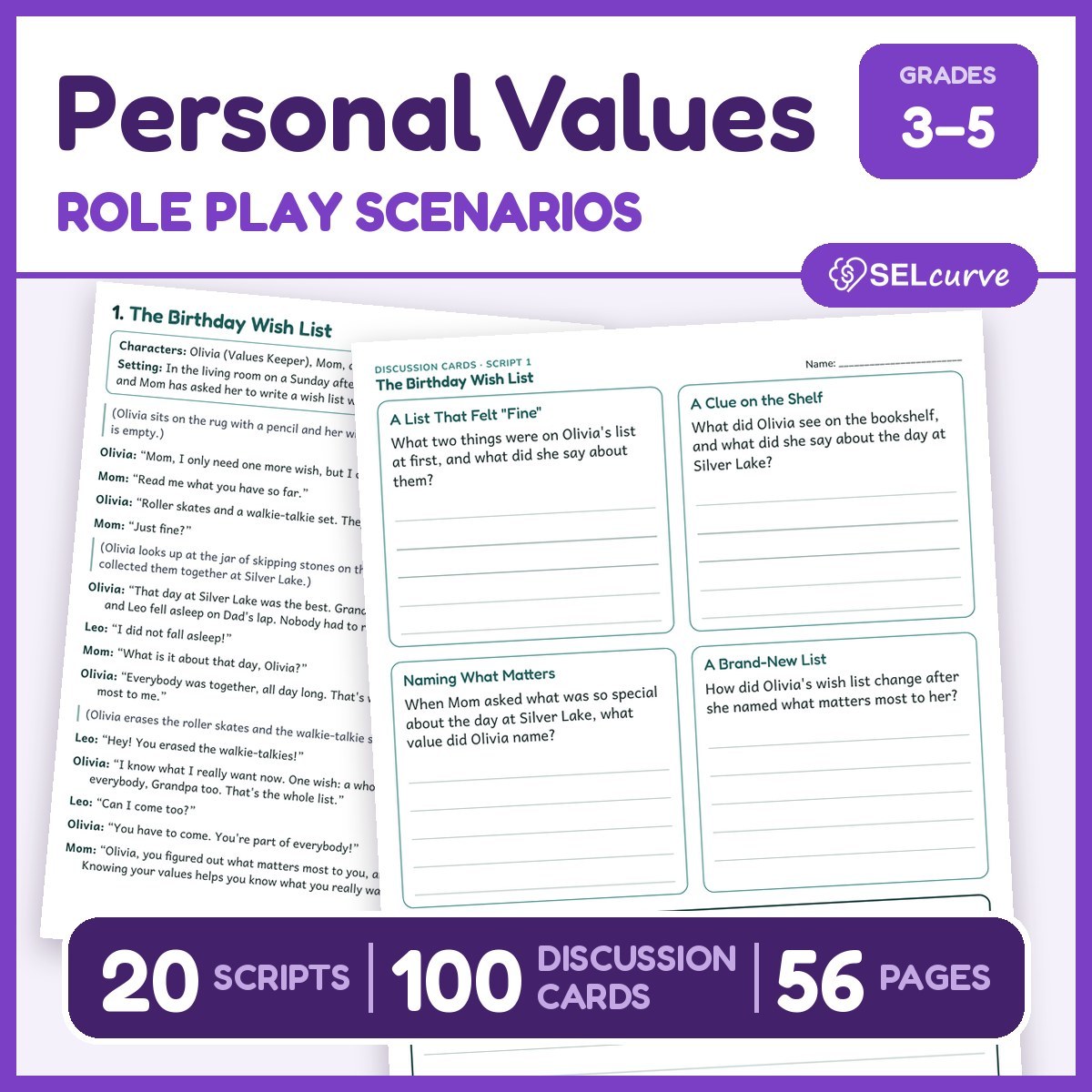
Personal Values Role Play Scenarios
- 100 discussion cards
- Printable
 Free with a free accountSelf-Awareness Role Play Scenarios100 discussion cards · Printable
What a free account gives you
- 81 free resources across all five SEL areas, ready to print
- Digital activities: post them in Google Classroom or Teams. Any device · No student logins
- A planner and collections to keep your SEL week organized
- Grades
- 3–5
- What you get
- 20 role play scripts
- Type
- Role Play
- Use it
- PrintView & Print in your browser
- Competency
- Self-Awareness
- Topic
- Personal Values
About this resource
With these personal values role play scenarios, Grades 3–5 work through 20 scripts in which the Values Keeper names something that matters and lets it guide a choice. Sofia fills a five-item shelf with a chipped yo-yo and a faded friendship bracelet and sends a never-used lamp to the storage box; Omar explains why he oils his grandpa’s old baseball glove every week; Elena chooses between a once-a-month fishing morning with Grandpa and a duck count on the pond. It is a Self-Awareness resource. Find more in our personal values activities.
What students practice
The scenes explore five sides of personal values:
- Knowing what matters to me
- Using my values to choose
- Explaining why something matters to me
- When two values pull apart
- Learning from a role model
Right for your grade
Grades 3–5
Grades 3–5 students are ready to move past “I just like it” and put values into words. The scenes use things they care about, like a soccer team, a best friend, a class time capsule or a Sunday pancake breakfast, and students can follow the script or say the lines their own way.
Everything included
What’s inside these personal values role play scripts for kids
- 20 role play scripts built on everyday values like kindness, fairness, honesty, responsibility, courage, friendship, family, working hard and learning
- 100 discussion cards, five behind each script, with the last card in every set about the student
- A detailed script and an activity outline, so you can lead the lesson word for word or in your own words
- An 11-page teacher guide with objectives, materials, tips for keeping values talk neutral and a printing guide
- A Family Connection page with two notes to send home


A look inside
Real pages, real moments
In the classroom
How to use these personal values role play scenarios
- 1Introduction (5–7 min): keep the tone warm and non-judgmental and ask, “If you could spend a whole Saturday doing anything at all, what would you do?” Then introduce a value as something that matters a lot to you.
- 2Main activity (10–15 min): cast the Values Keeper, the friend or family member with another idea and the grown-up who asks a good question. After the scene, ask what mattered most to the character and how it changed what they did.
- 3Sharing & discussion (5–10 min): ask whether someone else in the scene could hold a different value and still make a good choice, and welcome every value students name.
- 4Like a looser plan? The activity outline gives each step and its goal without a full script.
Printing and prep
Ready to print
- Scripts and discussion cards: plain paper, double-sided, flip on the long edge, a script on one side and its 5 cards on the other.
- Family Connection: plain paper, one-sided; two identical notes per page, cut in half.
- Props are optional and easy to find, such as a yo-yo, a small rock, a sketchbook or a deck of cards.
Questions teachers ask
FAQ
Do these personal values role play scenarios teach students what to value?
No. The guide says the activity isn’t about telling kids what they should value or about any family’s beliefs or rules. It focuses on everyday values and helps each student name what matters to them.
Is there a right answer in each scene?
No. Every student’s values are their own, and there is no single right answer. The discussion asks whether someone with a different value could still make a good choice.
Do I need a values word list?
It’s optional. The guide suggests a simple list of everyday values, like kindness, fairness, honesty, responsibility, courage, friendship, family, working hard and learning, as a visual aid.
What does one lesson look like?
A Saturday-question warm-up (5–7 minutes), one acted scene with questions (10–15 minutes) and a closing talk about values (5–10 minutes).
More for Self-Awareness
See all in the library →
Try it in class this week
Start with the free Self-Awareness Role Play Scenarios, or unlock it with Monthly.


