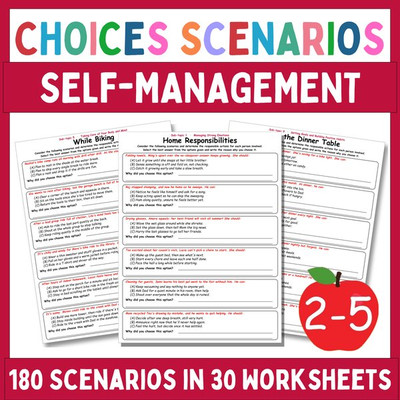
Full library·Grades 2–5·Self-Management·Worksheets · Choices Scenarios
Motivation Worksheets
Getting started is often the hardest part.
- 180 motivation scenarios
- 4 teacher pages
- Print + digital
In the full library, with 9 more on Self-Motivation
Task cards, scenario cards, role play and more (grades K–6).
Get the free Self-Management WorksheetsFree account · school email works · See the full library
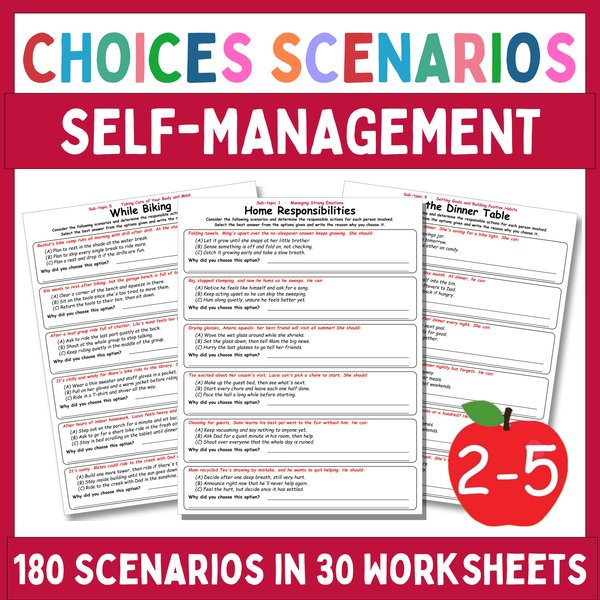 Same format, free with a free account: Self-Management WorksheetsOpen it →
- Grades
- 2–5
- What you get
- 180 motivation scenarios on 30 printable works…35 pages
- Type
- Worksheets
- Use it
- Print + digitaldigital = any device, no student logins
- Competency
- Self-Management
- Topic
- Self-Motivation
About this resource
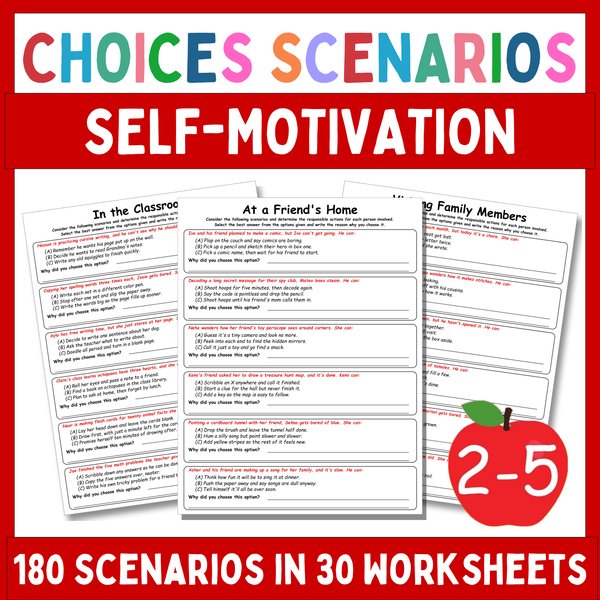
Getting started is often the hardest part. These motivation worksheets give Grades 2–5 180 small moments where a child has to find their own push: a comic that won’t get going, thirty balloons to blow up, a chess club that feels pointless today. Students pick A, B or C and say why, and the focus stays on inner reasons rather than praise, which makes it Self-Management practice they can carry into the next long assignment.
What students practice
- Getting started on a task they’ve put off
- Pushing through boredom and tiredness
- Following their own curiosity
- Finding their own reason for doing something
- Using short breaks and small rewards wisely
- Doing a little more than the minimum
What’s inside
- Choices A, B and C plus a “Why did you choose this option?” line on every item
A look inside
- ARemember he wants his page put up on the wall.
- BDecide he wants to read Grandma’s notes.
- CWrite any old squiggles to finish quickly.
Curiosity items start with a question: “Sana wonders how the robot vacuum knows where the walls are.” The options range from reading its guide to calling robots boring.
Doing-more items start when the job is done: Ivy has “found everything on her half of the shopping list.”
How to use these motivation worksheets
Grade fit
The tasks are ones Grades 2–5 really face, drying dishes, warm-up laps, practicing cursive, a long story for the class book, and each scenario fits in two lines. Older students can go further in their reasons, which is where the difference between doing it for praise and doing it for yourself shows up.
Digital version
In the interactive digital version, students pick A, B or C and type their reason, or just pick if you choose the choices-only format, on any device with no student logins. At the end they download an answer sheet to hand in.
Pairs well with

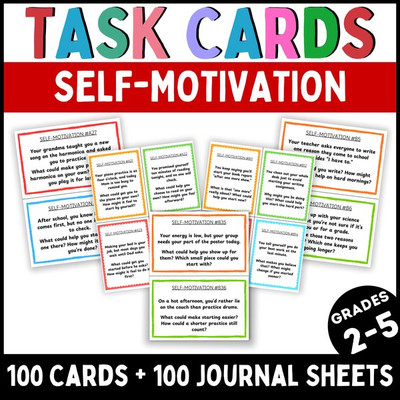
Questions teachers ask
Is there an answer key?
Not as a separate page. The scoring note explains that the strongest choice comes from the person’s own push, such as starting now or a short break, while relying on praise or rushing is weaker and quitting is poorest.
My second graders struggle to write. Will this still work?
Yes. Read the scenarios aloud and discuss them, or set the digital version to the choices-only format so students just pick A, B or C.
More for Self-Management
See all in the library →


Every resource, one library.
701 SEL resources for elementary classrooms — printables, digital activities and answer sheets, and every new one we add.