Full library·Grades 2–5·Self-Awareness·Task Cards · Stop Think Act Cards
Body Awareness Stop Think Act Cards
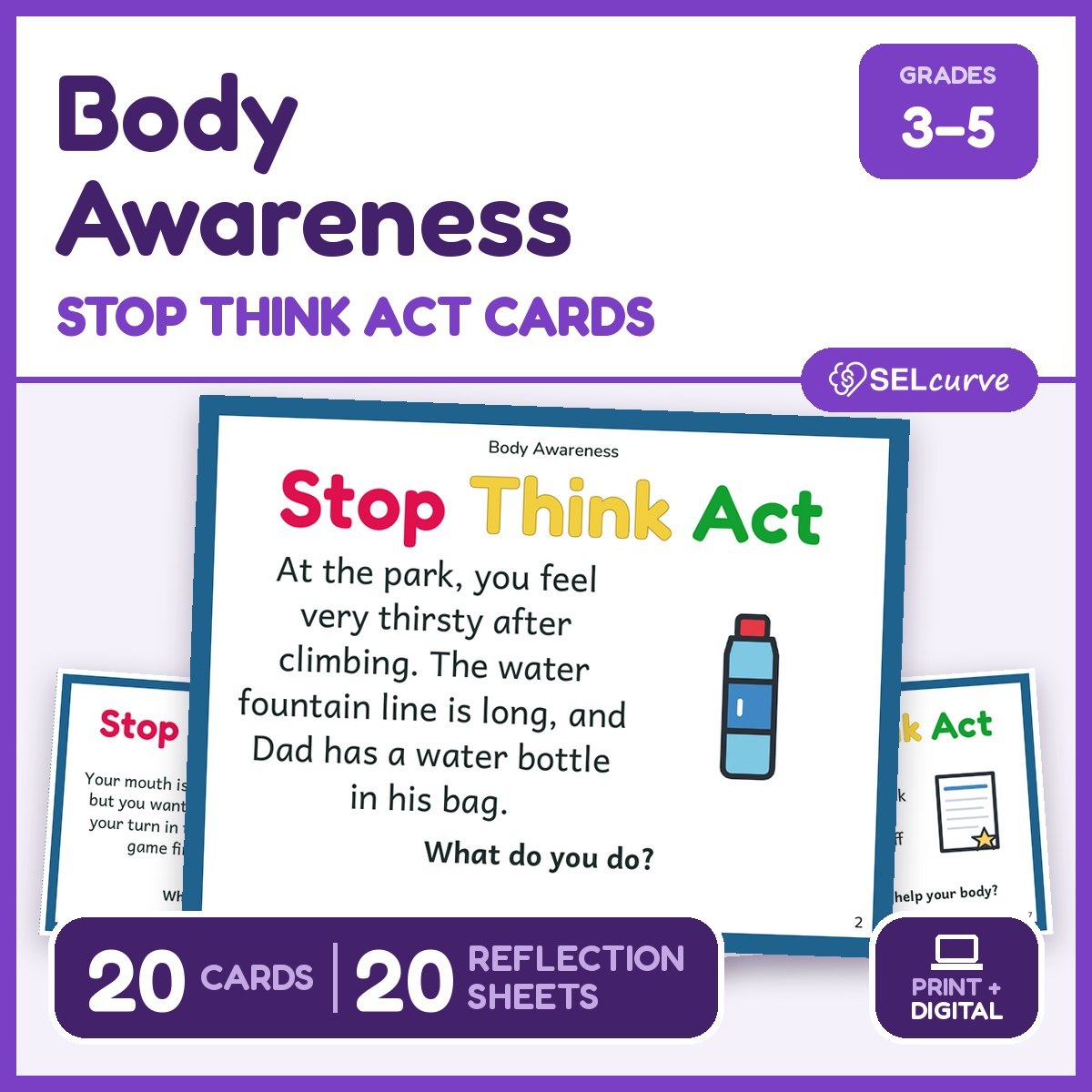
Heavy eyes during reading time, a mouth gone dry in the middle of a class game, legs that feel wiggly after a long time at the family party table: our body awareness stop think act cards give Grades 3–5 twenty simple body signals to notice and act on.
- 20 Stop Think Act cards
- 20 reflection sheets
- Print + digital
In the full library, with 7 more on Body Awareness
Scenario cards, worksheets, role play and more (grades 2–8).
Get the free Self-Awareness Stop Think Act CardsFree account · school email works · See the full library
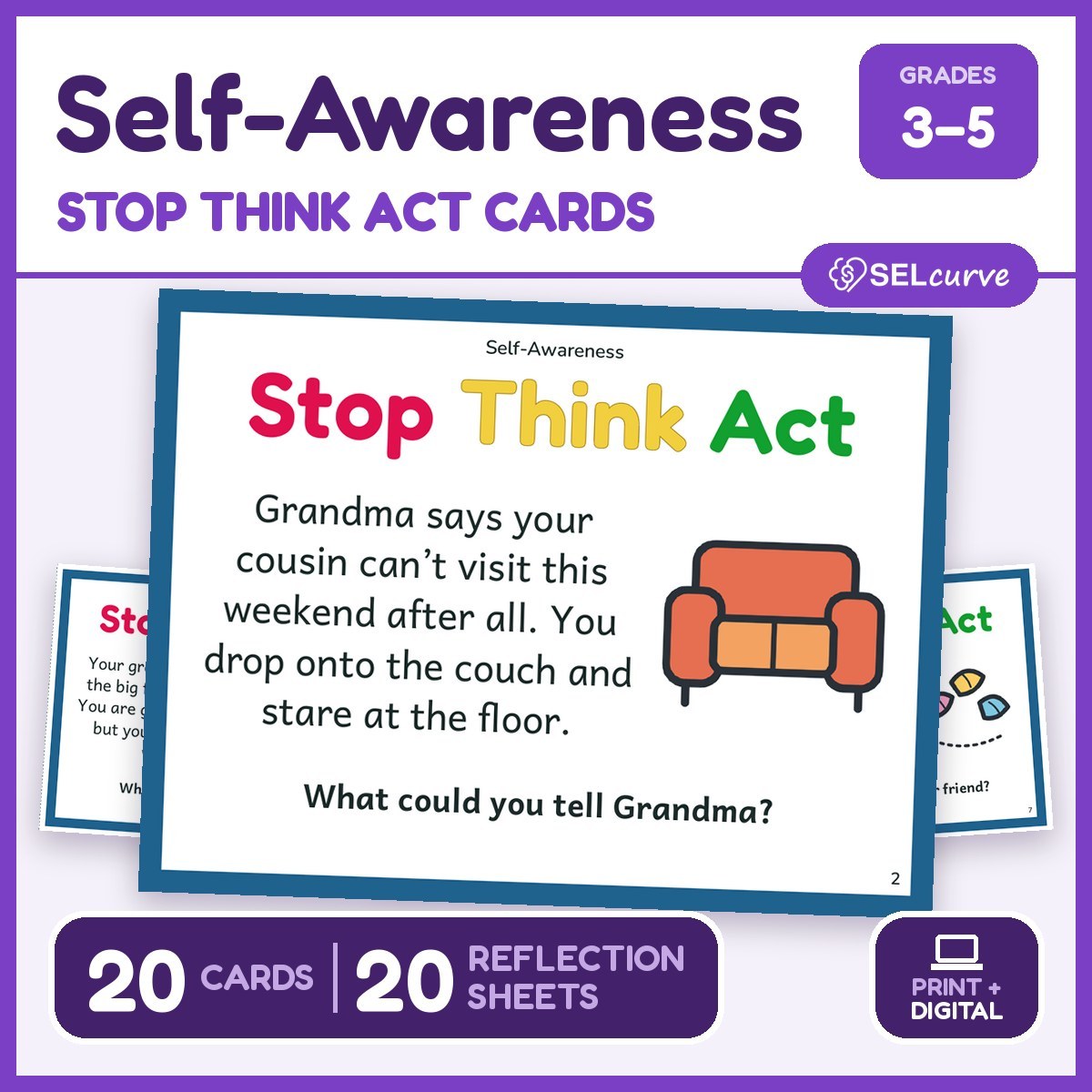 Same format, free with a free account: Self-Awareness Stop Think Act CardsOpen it →
- Grades
- 2–5
- What you get
- 20 Stop Think Act cards
- Type
- Task Cards
- Use it
- Print + digitaldigital = any device, no student logins
- Competency
- Self-Awareness
- Topic
- Body Awareness
About this resource
Heavy eyes during reading time, a mouth gone dry in the middle of a class game, legs that feel wiggly after a long time at the family party table: our body awareness stop think act cards give Grades 3–5 twenty simple body signals to notice and act on. On each card, students name what their body is telling them, then pick a helpful next step or the grown-up they could ask. It is a Self-Awareness resource. Find more in our body awareness activities.
What students practice
- Hunger, thirst and tiredness
- Body signs of worry or excitement
- Too much or too little energy
- Feeling too hot, too cold or in a place that is too loud
- Telling someone when they feel unwell
What’s inside these think before you act body awareness cards
- Full-page and four-per-page versions of the same cards, for class talks and display or for cutting into small-group and station sets
- A 4-page teacher guide with a step-by-step discussion plan, tips and differentiation, plus Cards at a Glance and a printing guide
- A Family Connection page with a quick body scan to try at home, and a digital activity for any device, with no student logins
A look inside
Card 7: “You have been writing your report at your desk for a long time. Your neck and back feel stiff and sore.” Then: “What could you do to help your body?”
Card 10: “It is raining, and you have to stay inside. You have so much energy that you can’t stop running around the room.”
How to lead a body signals discussion
- Read the moment: share a card aloud and ask students to imagine they are there.
- Name the signal: what signal is the body sending, what does it need, and who could help? Give students simple words like hungry, thirsty, tired or too hot.
- Pick a step and role-play it: brainstorm two or three helpful steps, pick the one that takes care of the need first, and role-play asking a grown-up for it.
- Reflect: use the card’s reflection sheet, or post the digital activity in Google Classroom or Teams, or show a QR code. Students answer on any device and send you their answer sheet.
Grade fit
The cards stick to simple signals in Grades 3–5 settings. Younger students start with the sentence starter “My body feels… I need…” and work through a card with you. Older students explain which signal on the card needs care first, and why, and mixed-ability pairs can match each card to a body signal word. The guide also offers a three-step routine to post by the door: “Notice it. Name it. Take care of it.”
Printing
- Full-page cards: one-sided on cardstock or plain paper, printed sideways so each card fills the page.
- Four-per-page cards: cardstock or plain paper, one-sided. Cut along the dashed lines; laminating lets you reuse them.
- Reflection sheets and Family Connection: plain paper, one-sided. The family page holds two take-home notes to cut in half.
Good to know
The cards never describe symptoms or medicine: feeling unwell always leads to telling a teacher, the school nurse or another trusted grown-up. Students may always pass, and nobody names a classmate: the talk stays on the moment on the card.
Questions teachers ask
Do the cards talk about illness or medicine?
No. The guide notes that the cards never describe symptoms or medicine. When a card shows a student who does not feel well, the answer is to tell a grown-up early.
What grade level are these body awareness stop think act cards?
Grades 3–5. Younger students use sentence starters with your support, and older students explain which signal needs care first.
Do the cards include feelings as well as body needs?
Yes. Alongside hunger, thirst, tiredness, energy, temperature and noise, some cards help students notice body signs of worry or excitement.
Can I assign it on devices?
Yes. Post it in Google Classroom or Teams, or show a QR code. Students work on any device with no student logins and send you their answer sheet.
More for Self-Awareness
See all in the library →
Every resource, one library.
775 SEL resources for elementary classrooms — printables, digital activities and answer sheets, and every new one we add.